Automated trading shouldn't be run in a black box.
Monitor Bot Health in near real time, validate Strategy Rules before risking capital, and review plain-language recaps of what your systems actually did. Keep live automation visible, reviewable, and within defined risk boundaries.
Automation you can explain — not just execute.
New to automated trading? Start here →Check your TradingView webhook payload before setup →Connection
ValidLast activity
12m agoExec drift
WatchDrawdown
NormalBehaviour
ReviewLast successful activity
ETH/USDT — Binance
Order filled · 14:03:09 UTC
Fill within expected range
Last alert execution
SOL/USDT — OKX: fills outside expected range · Needs review surfaced 47s after anomaly detected
Plain-language recap — last 4h
14 alerts · 14 routed · 12 filled · 2 outside range
ETH grid ran within normal parameters. SOL fills drifted above baseline — likely cause: spread widened during low-liquidity window. Next: review SOL grid spacing.
Recent changes
You changed SOL grid spacing 0.8% → 1.2%; activity normalised within 2h.
System re-authorised OKX key; connection restored; no missed alerts.
Paper environment · Multi-exchange workspace · Backtesting-ready
Crypto spot and futures first · Paper-to-Live workflow · Certification-led coverage
Operational Assurance
Verifiable by design — built for evidence-based oversight.
See what's ready, what's restricted, and what's still being validated — so you can assess automation with evidence, not assumptions.
Trust controls
Trade-only permissions
EnforcedConnections use the minimum scope required to execute strategies.
scope · trade / read
No withdrawal access
BlockedWithdrawal permissions are blocked by default and cannot be enabled in-app.
withdrawal · disabled
Paper-first activation
DefaultStrategies validate in Paper before any Live capital path opens.
go-live gate · Paper required
Signal-to-Fill traceability
TracedEach routed alert is acknowledged and traced from source to fill.
path · alert → order → fill
Coverage & workspace capabilities
Certified exchange paths
Certification-ledCoverage expands through controlled validation of exchange paths, market data, and execution readiness.
model · not unchecked listing
Spot & futures coverage
ExpandingDesigned for spot and futures markets as certified coverage expands.
status · target coverage
Chart-linked strategy review
Built-inBuilt-in Chart Workspace links market structure to Strategy Rules, backtests, and Bot Health.
surface · in product
Multi-timeframe backtesting
Built to supportBuilt to support backtesting across multiple timeframes and defined review windows.
windows · 7d → 3y
Capability
Choose the execution path that fits your workflow.
Vordant supports two operating modes: TradingView Strategy Mode for alert-driven automation, and Vordant Strategy Mode for native Strategy Rules, validation, and Paper-to-Live oversight.
Mode 1
TradingView Strategy Mode
For traders already using TradingView strategies, alerts, and external signal logic.
Source / input
TradingView alerts / strategies
Best for
Traders who want to keep their TradingView logic while using Vordant for oversight and execution control.
Vordant handles
Mode 2
Vordant Strategy Mode
For traders who want native Strategy Rules, validation, backtesting, and a tighter Paper-to-Live workflow inside Vordant.
Source / input
Vordant-native Strategy Rules
Best for
Traders who want structured rule validation and native operational workflow control.
Vordant handles
Shared layer
Both modes feed into the same operational layer: Bot Health, Pre-Flight readiness, Signal-to-Fill traceability, Chart Workspace, and execution review.
Chart Workspace
Review strategy context without leaving the workspace.
Use Vordant's built-in Chart Workspace to inspect market structure, review Strategy Rules, compare Backtest context, and monitor Bot Health from the same operational environment.
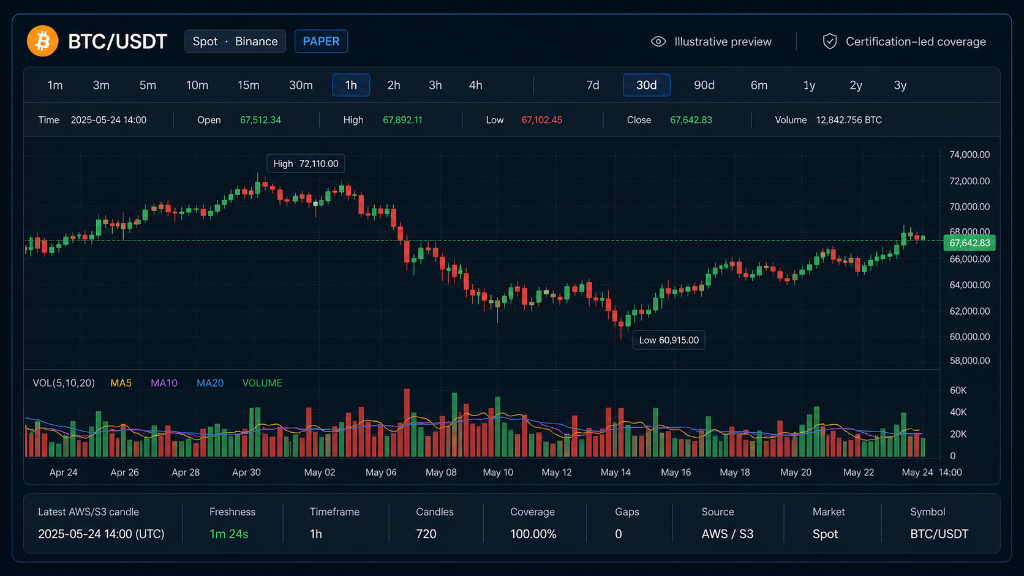
Linked to Strategy Rules
Chart context connects directly to the Strategy Rules that govern signal evaluation and execution conditions.
Backtest reference layer
Review Backtest windows alongside live chart structure to validate strategy assumptions before paper execution.
Operational, not decorative
Chart Workspace is an operational review surface — not a trading terminal. It is designed for context, not order placement.
Backtesting & Strategy Validation
Backtest strategies across timeframes before they reach live execution.
Designed to support backtesting across spot and futures markets, 10 timeframes, and 7 review windows as certified market-data coverage expands.
Evaluate strategy behavior across multiple timeframes and defined historical windows before promoting automation from Paper to Live. Coverage is presented as capability and roadmap — each market and timeframe carries its real certification status.
Timeframes
Review windows
| Market | 1m | 3m | 5m | 10m | 15m | 30m | 1h | 2h | 3h | 4h |
|---|---|---|---|---|---|---|---|---|---|---|
| SpotCertified paths | ||||||||||
| FuturesIn certification |
Status shown for layout. Real certification status is applied per market, timeframe, and venue.
Exchange & Market Coverage
Coverage earned through certification, not scale claims.
Vordant is being built toward certification-led coverage across 8 exchanges, 60 spot pairs, and 30 futures pairs — enabled through controlled validation of exchange paths, market-data coverage, and execution readiness.
8
Target exchange coverage
certification-led
60
Target spot-pair coverage
as certified
30
Target futures-pair coverage
as certified
Figures represent target coverage, not a live listing. Each path goes Live only as it is certified.
See what your bots did
What happened — and what changed.
Plain-language recaps tell you what your strategies did and whether anything needs attention. The audit trail shows what changed, who changed it, and what happened next.
Reviewing what changed is part of running automation responsibly.
14 alerts · 14 routed · 12 filled · 2 outside expected range
ETH grid ran within normal parameters throughout the session. SOL fills drifted above baseline on one session — likely cause: spread widened during a low-liquidity window between 13:40 and 14:05 UTC.
You changed SOL grid spacing 0.8% → 1.2%; activity normalised within 2h.
Today · 11:22 UTC · You
System re-authorised OKX key; connection restored; no missed alerts after reconnect.
Today · 09:41 UTC · System
TradingView alert received; Binance accepted order; fill completed within expected range.
Today · 14:03 UTC · TradingView → Binance
ETH drawdown threshold adjusted 8% → 10%; no limit events since change.
Yesterday · 18:05 UTC · You
Security & permissions
Your funds stay yours.
We can trade on your behalf — we can never withdraw your funds.
Vordant connects to your exchanges using trade-only API permissions — the minimum needed to execute strategies. Withdrawal access is blocked by default, and every connection and key event is logged and visible to you.
You see a visible permission summary before any connection is activated. No silent access, no broad keys, no exceptions.
Plans
Plans built around trading operations
Vordant scales by operational capability — from solo validation to deeper execution visibility and team oversight.
Vordant Core
For individual traders building disciplined paper-to-live workflows.
Vordant Pro
Most PopularFor active traders who need expanded automation, intelligence, and strategy visibility.
Vordant Operator
For serious operators using advanced protection controls and live-readiness workflows.
Controlled rollout
Final launch pricing will be announced before public availability.
FAQ
Common questions
Free Tools
Diagnostic and preparation tools — no account required.
Use these tools to prepare, validate, and review before connecting your exchange or running live.
Strategy Readiness Evaluator
Review whether a strategy is ready for structured validation before Paper deployment. Surfaces blockers and unsupported logic up front.
Strategy Timeframe Evaluator
Identify practical timeframes for a strategy before deeper backtesting or Paper validation. It does not replace backtesting or Paper validation.
TradingView Webhook Tester
Inspect your TradingView alert webhook payload before connecting.
Strategy Rule Converter
Convert manual strategy rules into structured Vordant setup guidance.
Strategy Import Readiness Checker
Check whether an existing bot setup can be reviewed inside Vordant.
Pine Script Strategy Draft Converter
Generate a reviewable draft from a Pine Script strategy; unsupported logic is flagged before Paper validation.